Fractionating Column
Ivo Sarn
Six pieces named after the six cuts a refinery tower makes, from the light gas at the top to the tar that will not move. Recorded in one week in a stairwell in Katendrecht.
An independent record label for ambient, electronic
and one or two things that don't have a word yet.
Music is the last thing
that happens to a dinosaur.
Eight releases · 2017–2026 · Rotterdam & Sheffield
Scroll to go down through them
Naphtha is the fraction of crude that boils off between thirty and two hundred degrees. Crack it, chlorinate it, chain the molecules end to end and you have polyvinyl chloride. Pelletise that, warm it to a hundred and sixty, and you get a biscuit — a soft black puck about the size of a scone.
Squeeze the biscuit between two nickel stampers at a hundred tonnes and it becomes twenty-two minutes of a person playing something. Everything on this page came out of the ground.
Eight releases since 2017. Ambient, electronic, and a few things that don't have a word yet. Below you is the catalogue, arranged the way it actually sits — the newest record floating near the surface, the first one at the bottom, and ten years of material in between.
You are going down through it now. Depth here is not a mood — it is chronology. Every metre you fall is a month of the label, and the gaps between the records are real gaps, drawn to scale.
Pull a sleeve out as you pass it. The whole column takes that record's colour.
Ivo Sarn
Six pieces named after the six cuts a refinery tower makes, from the light gas at the top to the tar that will not move. Recorded in one week in a stairwell in Katendrecht.
Correction Field
Forty minutes built from a single sustained note that was never actually played — it is the difference tone between two oscillators that are nearly, but not quite, in tune.
Marta Ourique
A chapel harmonium in Porto, four microphones, and the room doing most of the work. Nothing is added. The loudest thing on side B is the bellows.
Nils Bergrot
Named for the ring of waste PVC that squeezes out of the press and gets cut away. Bergrot recorded the plant itself for a fortnight and kept only the offcuts.
2021
Nothing. The plant we used in Alfreton shut in the March and it took the rest of the year to find another one that would take a run under a thousand.
This is what a year off looks like from the inside — twenty-four metres of oil and no records in it. We left the gap in rather than closing it up.
Hälleflinta
Salt is what traps oil underground: it creeps upward over millions of years and caps the reservoir. Six pieces about things that move too slowly to see.
Aleksy Mor
Cut direct to the aluminium-and-nitrocellulose disc the whole industry still calls a lacquer. One take, one lathe, no master tape. The mistakes are pressed in.
Kettle Fell
Forty-one minutes, no edit points. The title is roughly how long the algae that became this record spent on the seabed before anyone thought to pump it up.
Vesna Halász
Overburden is the rock you move to get at the thing you want. Tape organ, a broken Rhodes and a contact mic on a radiator. Two hundred and fifty copies, all of them long gone.
Below the last record the field closes up. This is the sludge fraction — the heavy end, where the material stops behaving like a liquid and starts behaving like a decision.
Not a metaphor — the actual word, used by every pressing plant in Europe. Vinyl compound is extruded into a rope, chopped into pucks and dropped warm onto the lower stamper. It is roughly the size of a scone and it slumps under its own weight while you look at it.
Ours are 135 grams. Nobody outside the plant has ever seen one, which is why it is here.
The press closes for about six seconds. Steam at 150°C softens the puck, it spreads to fill the cavity, and the stampers push a groove three hundredths of a millimetre wide into it. Cold water goes through the same plates to set it. The waste ring is trimmed off while it is still warm.
Twenty-two minutes a side is not an artistic choice. It is how much groove fits before the stylus runs out of room.
We are two people and a shared unit behind a tyre place. We licence nothing, we sign nothing, and we press in runs of two hundred and fifty because that is what we can pay for up front.
The records are heavier than they need to be and the sleeves are printed on board that was never bleached. If a run sells out we usually leave it out of print, because the alternative is a second pressing that is slightly worse than the first.
Demos, in any state — demos@naphtha.rec
Distribution and press — trade@naphtha.rec
Unit 4, Delfshavenselaan 22, Rotterdam · and a garage in S6
We answer everything, slowly. If you send a link rather than a file we will listen to it sooner.
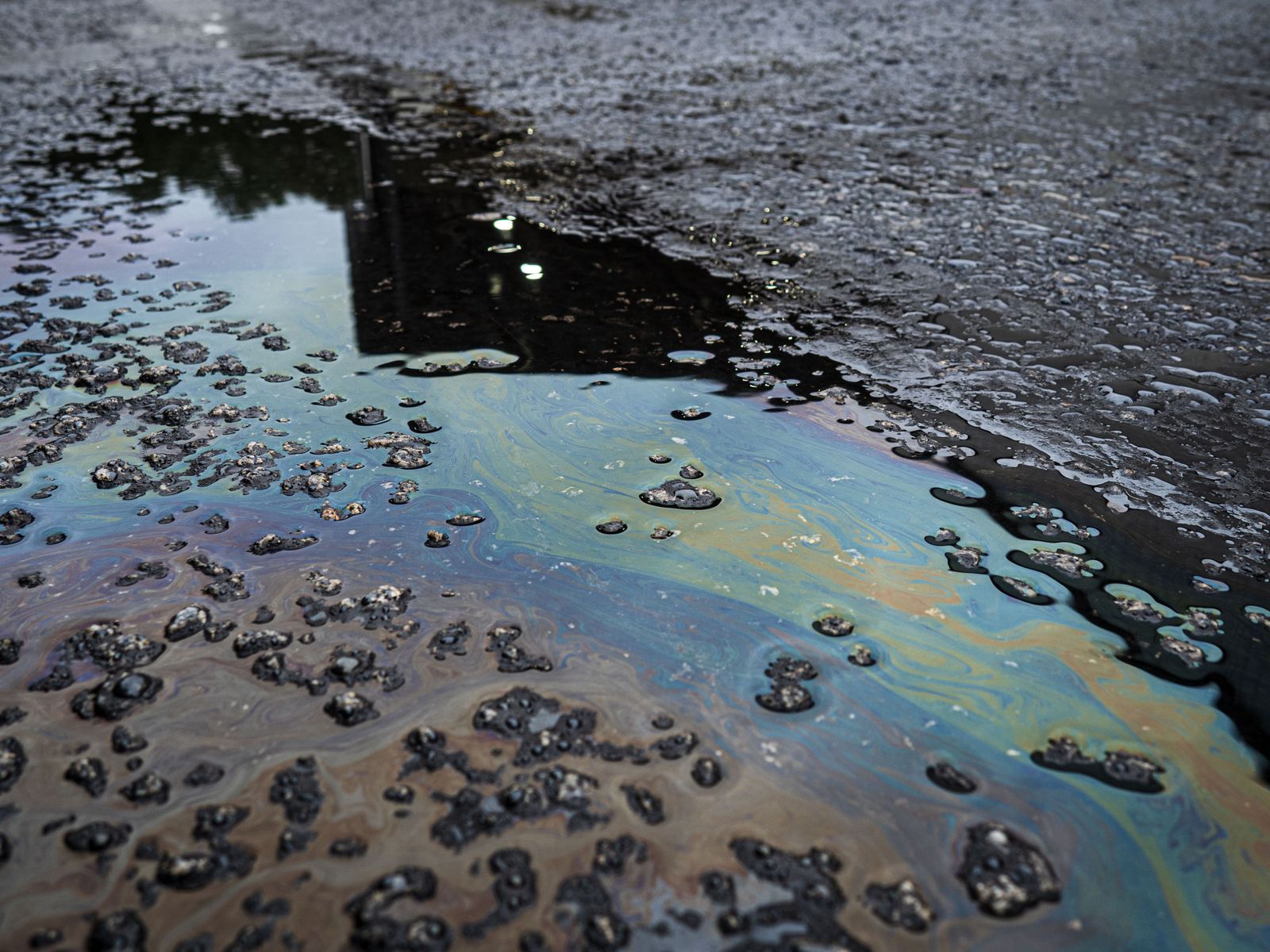
Photograph: Jared Brotman / Pexels. Environment lighting: Poly Haven, CC0. Type: Tanker and Synonym, Fontshare. Nothing on this page is stock except the puddle, and the puddle is the point.
NAPHTHA is a fictional label built as a design exercise. The records do not exist. The pressing process does.